
ITE Nevada Section Blog
Welcome to the ITE Nevada Section Monthly Blog!
Blog posts will be updated on this page on a monthly basis. Should you have any questions or suggestions to improve this page, please contact Nicholas Portugal ([email protected]) at your earliest convenience.
May 2026 - Completion of the PedSafe Vegas Traffic Garden Project
Over the past few months, the ITE Nevada Section provided support to the PedSafe Vegas Traffic Garden Project, led by Erin Breen, Director of PedSafe Vegas. We would like to recognize two board committee members for their noteworthy contributions to this effort, namely Alma Al-Fawal (Community Outreach Chair) and Nicholas Portugal (Communications Chair). Alma served as project coordinator between the Nevada Section and Erin Breen, while Nicholas provided site design and plan production support. The project site plan was finalized and approved by PedSafe Vegas as of late April 2026 and Las Vegas Paving has been selected as the Contractor.
The mission of the Traffic Garden Project is to provide a safe space for children to operate miniature vehicles under their parents' supervision while learning how to appropriately approach and navigate different types of road situations, including roundabouts, T-bone intersections, and a four-way stop-controlled intersection with crosswalks. The primary constraint our project team identified during the design process was accommodating the compact size of the project site, as our objective was to consolidate a total of three (3) conceptual site layouts provided by PedSafe Vegas into an area measuring fifty (50) feet wide and 200 feet long. Each of the three conceptual layouts was planned to occupy a specific site footprint and far exceeded the available 50-foot width for the selected site.
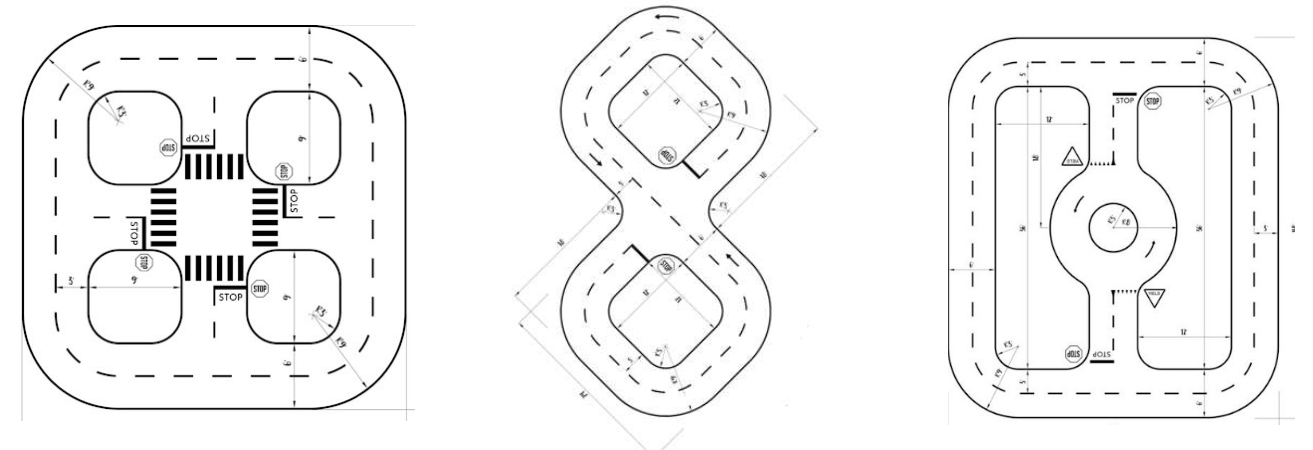
The site design and coordination process could best be described as iterative, insightful, and meaningful, as consolidating multiple site layouts into one site, let alone a single site layout, is a time-consuming and challenging task. Firstly, to discuss draft site design layouts and design feedback, the project team regularly engaged in coordination meetings over the Zoom platform. Secondly, to execute the site, roadway, signing and striping design, Nicholas used a personal license of AutoCAD for Mac 2024 and Apple Preview to finalize and share the final site plan. The final site plan incorporated all three conceptual site layouts optimized to fit within the available site parameters, complete with a 4-foot wide paved road bordering proposed chainlink fencing dotting the site perimeter, painted white stop bars, painted white crosswalk bars, painted broken white lane lines, painted white yield lines, painted white straight arrows per NDOT Standard Plan ST-4, 2-foot wide Type L-Curb per RTC Standard Drawing 216, depressed concrete curb per RTC Standard Drawing 223, and concrete sidewalk per RTC Standard Drawing 234 to provide internal pedestrian access and enable parents and guardians to supervise their children. The project team agreed that the Contractor, Las Vegas Paving, should have the final say with respect to methods of construction and material selection, while PedSafe Vegas and partner agency, Safe Kids Clark County, would oversee product selection and organize maintenance operations for child-friendly miniature vehicles to use on the Traffic Garden's internal 4-foot wide paved roads.
The ITE Nevada Section was incredibly proud to collaborate with PedSafe Vegas on this project and we look forward to witnessing how the Traffic Garden enriches the traffic education of our youth in Clark County in the project's ultimate build-out condition. Please stay tuned for a follow-up blog post and social media posts at that time. Should you have any inquiries about the Traffic Garden, we invite you to contact Erin Breen, Director of PedSafe Vegas, via email at [email protected]. We hope to engage in more inspiring community outreach activities and projects such as these in the near future, and building and maintaining connections with spectacular organizations such as PedSafe Vegas will enable the Nevada Section to accomplish this goal!
March 2025 - Reimagining Maryland Parkway with Bus Rapid Transit & Complete Streets Improvements
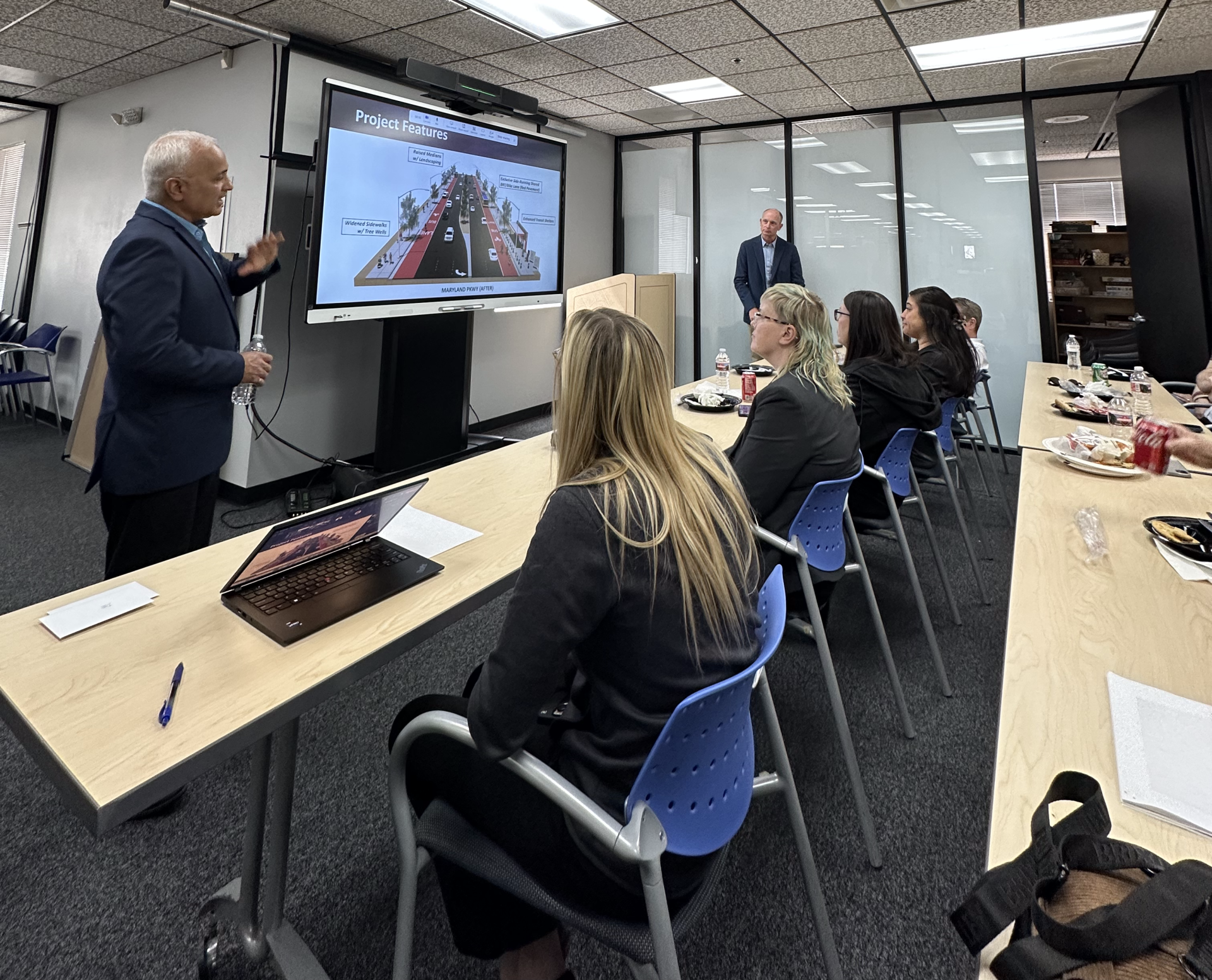
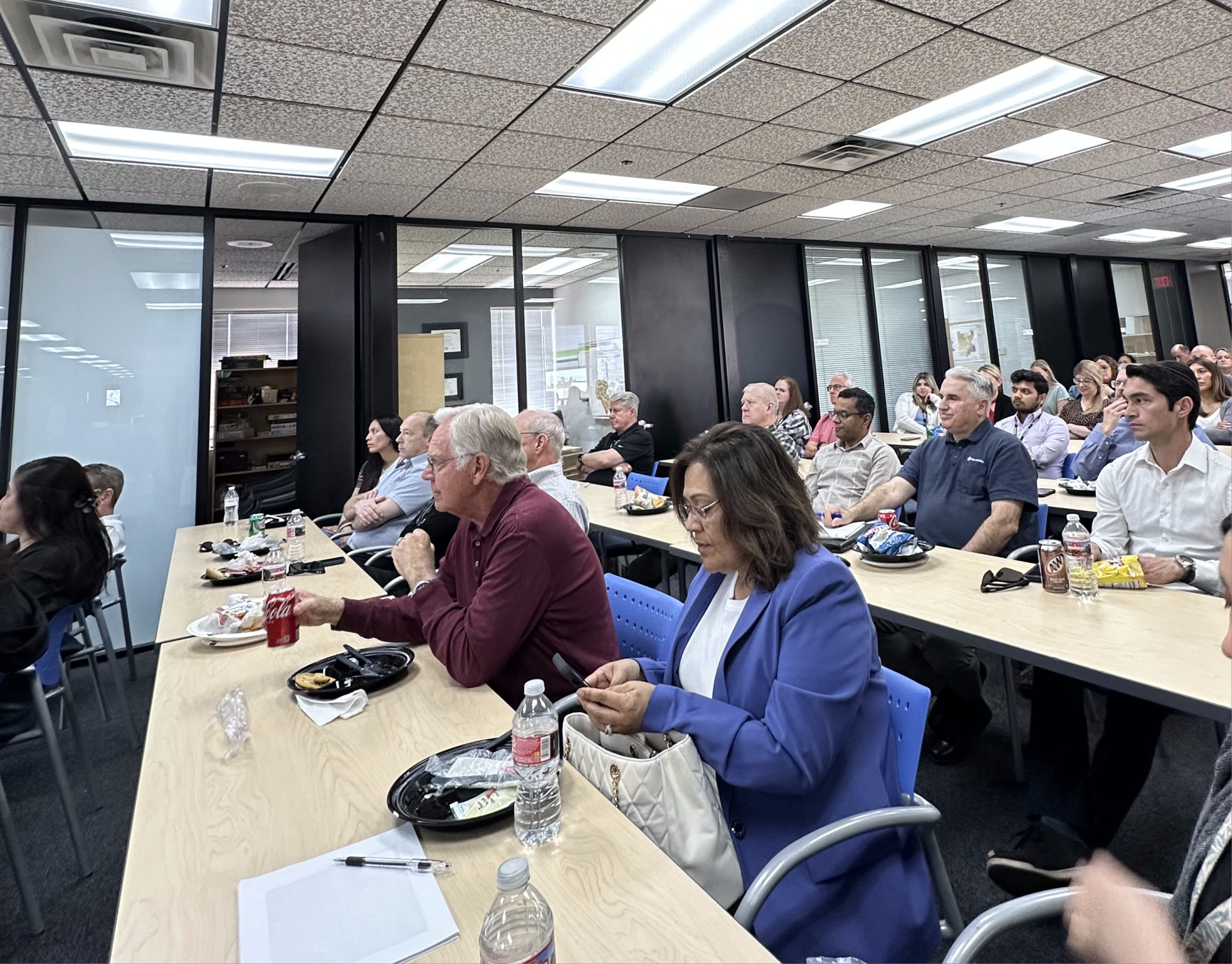
The Joint ITE/WTS March Luncheon at the G.C. Wallace office was a success; it was well-attended by engineering professionals representing several consulting firms, agencies, and professional societies. Tim McCoy (GCW) and Brij Gulati (RTC) presented the development, schedule, and current progress of the Maryland Parkway BRT project. As the title of this post suggests, the project will completely reimagine the current roadway, subsurface utility, traffic, and drainage design along Maryland Parkway, positively impacting the Las Vegas community from the South Strip Transit Terminal to the Bonneville Transit Center and Medical District in the Downtown area. Why was Maryland Parkway specifically selected for Complete Streets improvements, you may ask? The Maryland Parkway corridor is one of the busiest transit routes in the RTC system, connecting over 35,000 vehicles, 9,000 public transit users, and 63,000 residents alike in Las Vegas to over 109,000 jobs, the University of Nevada, Las Vegas, and Downtown Las Vegas. Construction has begun as of Summer 2024 and is scheduled for substantial completion by Fall 2026, culminating in an impressive 2-year turnaround timeframe.
The Maryland Parkway BRT project will upgrade and reconfigure aging infrastructure along the entire corridor to accommodate all types of road users while tremendously improving overall safety, air quality, mobility, traffic calming, and ADA/PROWAG-compliant access routes, to name just a few benefits. To ameliorate overall safety, ADA/PROWAG-compliant access, and reduce the existing urban heat island effect, the project shall construct 10'-wide attached sidewalks on both sides of the roadway, install bollards, and plant drought-tolerant landscaping and trees along walkways and medians. Large bus shelter structures with plenty of seating, expansive overhangs, and interactive map screens displaying RTC bus route information will be constructed adjacent to side-running red painted bus lanes on both sides of the corridor, which have proven effective in other communities. Existing midblock crossings will be upgraded to accommodate ADA/PROWAG-compliant access, incorporate Rectangular Rapid Flashing Beacons (RRFBs), and at intersections, traffic signal infrastructure upgrades will employ traffic signal priority to offer more efficient bus service. Subsurface utility improvements include ensuring minimum spacing requirements, measured from the proposed locations of curb and gutter, are satisfied by removing / replacing existing underground utility mains as well as installing new ITS, streetlight, and traffic signal conduits.
For more information and updates on the Maryland Parkway BRT project, please visit marylandparkway.com. Thank you to all who attended, and we look forward to welcoming you again at the April 2025 Luncheon at the RTC FAST/NDOT District 1 office!
